What "Candid" Actually Means, Beyond the Buzzword
Search the phrase and you will find the same three sentences recycled across a hundred studio websites: unposed, natural, emotional. True enough, and useless if you are trying to decide how to spend a meaningful part of your wedding budget.
Here is the working definition we use with our own couples. Candid photography is the practice of anticipating moments rather than arranging them. The photographer reads a room, knows where the next burst of laughter will come from, and is already standing there when it happens. Nothing about the frame is staged. Everything about the position is deliberate.
That distinction matters because it separates two very different jobs. One person waits for something to happen. The other has studied enough weddings to know it is about to.
Why the Term Has Become Nearly Meaningless
Any photographer with a fast lens can call themselves candid. The label costs nothing. What it hides is a set of skills that take years to build: reading body language across a crowded mandap, moving without drawing attention, and knowing which split second holds the real expression and which one holds the polite smile that came right after.
When couples tell us they want candid photos, what they usually mean is something more specific. They do not want to remember standing in a line, smiling on command, waiting for a photographer to check the back of the camera. They want to remember the wedding as it felt from inside it.
Candid Is Not the Same as Unedited or Unplanned
There is a persistent myth that candid work is what happens when nobody is directing anything. In practice, the best candid photography sits on top of heavy preparation. Timelines are built around light. Family groupings are handled in twenty focused minutes so the rest of the evening stays free. The photographer has walked the venue, knows where the sun will be at 5:40 pm, and has already decided which corridor gives the best frame for the baraat.
The freedom in the final images is real. It is also engineered.
How It Differs From Traditional and Editorial Coverage
Most couples are choosing between three broad approaches, often without clear language for the difference. Understanding what each one is built to do makes the decision far easier.
Traditional Wedding Photography
Built around a shot list: the ring exchange, the first look, every family combination, the cake cutting. Everyone knows where to stand. The results are reliable and complete, and the experience for the couple is largely one of being directed through a sequence.
Editorial Photography
Borrows from fashion and magazine work. Poses are intentional, lighting is controlled, and the couple is often asked to hold a position while the photographer refines the frame. The output is striking and composed, closer to a portrait series than a documentary.
Candid Photography
Leans documentary. The photographer works around the day rather than interrupting it. Portraits still happen, but they are usually brief and built from movement or conversation rather than rigid instruction. The bulk of the coverage is the wedding as it unfolds.
None of these is superior in the abstract. A couple who wants a precise, styled album will be happier with editorial. A family that values complete records of every relative will want traditional coverage. Candid suits couples who care most about how the day felt.
In practice, most weddings we shoot are a blend, weighted heavily toward candid with short, efficient portrait windows. That combination tends to serve everyone in the room.
What Candid Photography Looks Like Across an Indian Wedding
An Indian wedding is not a single event. It is a multi-day production with its own rhythms, and candid coverage has to adapt to each one. A photographer who only knows how to shoot a Western ceremony will miss most of what makes these days remarkable.
Mehndi and Haldi
These are the loosest, most tactile functions, and often the most rewarding to photograph. Henna being applied, cousins arguing over design choices, someone's grandmother inspecting the work. The light is frequently terrible and the rooms are crowded, which is exactly why anticipation matters more here than gear.
Sangeet and Cocktail Night
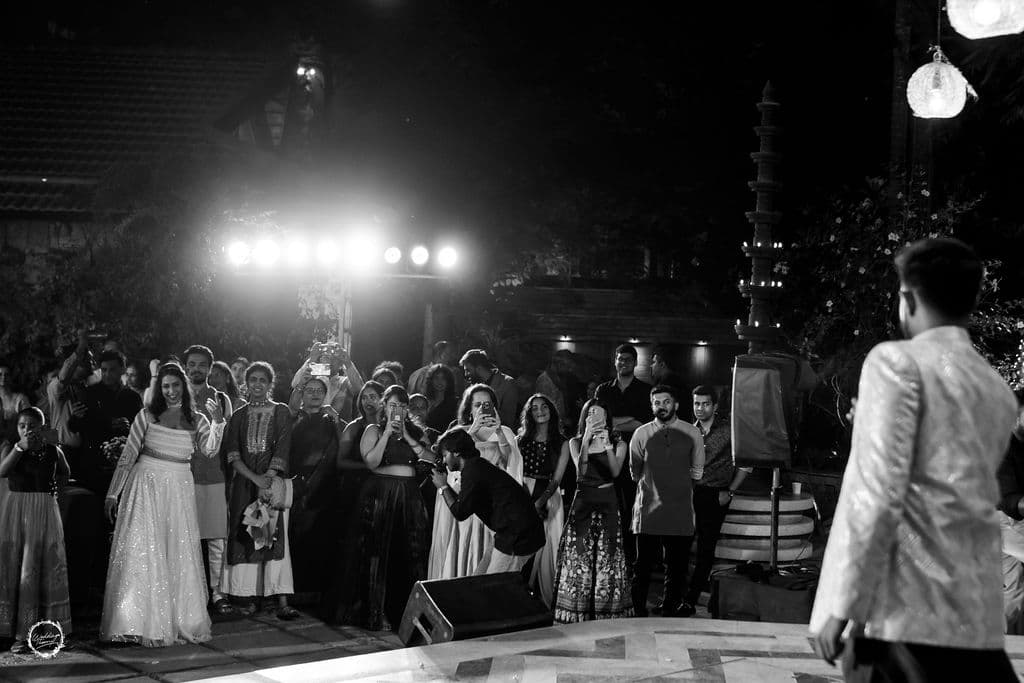
Movement, low light, and performance. This is where a photographer's understanding of stage lighting and dance floor chaos separates competent work from forgettable work. The best frames are rarely of the performance itself. They are of the parents watching it.
The Wedding Ceremony
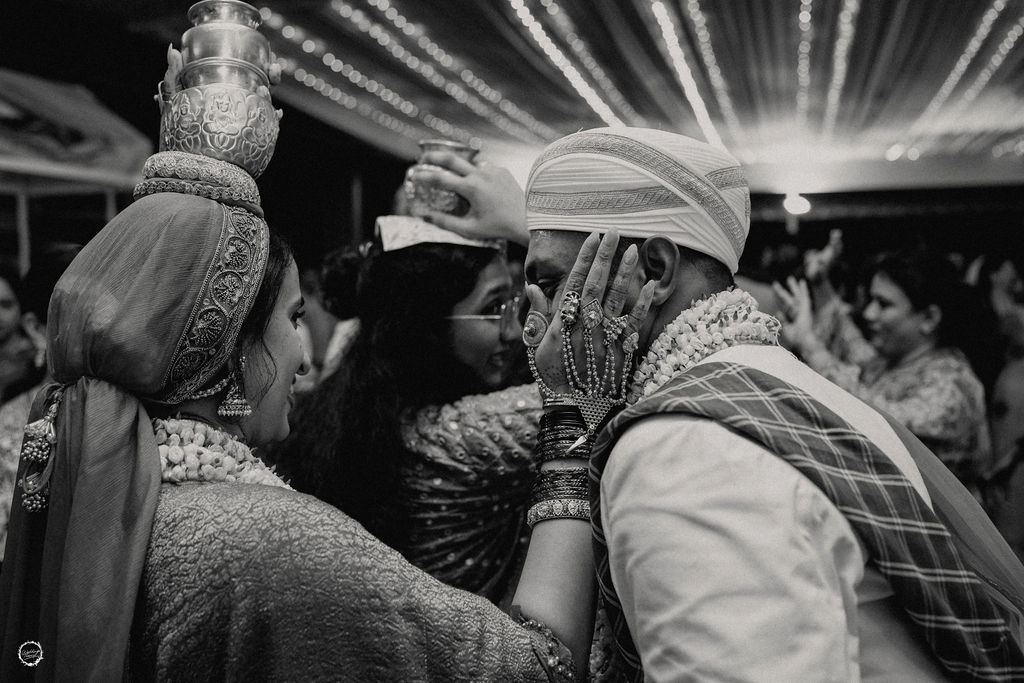
The mandap is a small space with enormous emotional density. The varmala, the kanyadaan, a father's hand hesitating before he lets go. These moments last two or three seconds. There is no second take.
The Reception
By this point, guests have relaxed and the formalities have loosened. Some of the most honest images of the entire wedding come from this window, long after the official programme has ended.
How to Tell If a Photographer Is Genuinely Good at This
Portfolios are curated. They show the best hundred frames from years of work. That is fine, but it means you need to read them differently than you would read a menu.
Look at the In-Between Frames
Ask to see a complete gallery from one wedding, not a highlight reel. The middle of a gallery tells you more than the cover. Are the candid frames as strong as the posed ones? Is there variety in the angles, or is every image shot from the same standing position? A photographer who only moves during the portrait session is not really shooting candid work.
Watch for Recurring Patterns
Every photographer has habits. Some lean on shallow depth of field to make ordinary moments look cinematic. Some convert everything to black and white. Neither is wrong, but if you notice the same trick repeated across an entire gallery, you are seeing a formula rather than a response to the moment.
Ask About the Uncomfortable Scenarios
A useful question: what do you do when the light is bad and the moment is happening anyway? The answer reveals whether you are talking to someone with technical depth or someone who relies on ideal conditions. Another: how do you handle a family member who keeps stepping in front of the camera? The response will tell you a great deal about temperament, which matters as much as talent on a four-day wedding.
Check Whether They Understand Your Specific Wedding
A photographer who has never shot a South Indian ceremony may not know that the muhurtham timing leaves almost no room for portraits. Someone unfamiliar with a Punjabi wedding may not anticipate how quickly the doli moment arrives and passes. Regional fluency is not a nice-to-have. It is the difference between catching the moment and hearing about it afterwards.
What to Expect From the Experience Itself
The photographs are the outcome, but the process matters too, because you will spend more hours with your photography team than with almost anyone else at your wedding.
A good candid photographer is present without being intrusive. They will talk to your cousins, learn names, and become a familiar presence within the first hour. By the time the ceremony begins, nobody is conscious of the camera, which is precisely the point.
Expect very little direction and a few well-timed suggestions. Expect the photographer to disappear during the quiet moments and reappear exactly when something is about to happen. Expect to forget they are there, and then to be surprised, weeks later, by how much they saw.
If you are weighing options for your own wedding and want to see what this looks like in practice, the most useful next step is to look at full galleries rather than highlights, and to ask the questions above directly. The right photographer will welcome them.