
The Real Problem With Crowded Venues
Every couple envisions their wedding photos as intimate, unhurried, and perfectly composed. Then the day arrives, and the room is packed. Aunties cluster around the stage, cousins dart between tables, and the caterer's team weaves through with trays of chai. The vision of a serene portrait session feels like a different event entirely.
The instinct is to panic, or to blame the venue. Neither helps. Crowds are not the enemy of good photography. They are a variable, like weather or lighting, and they can be worked with if you know what you are doing.
This guide is for couples who want honest, practical advice on how to get stunning photos even when the space is packed. It is also for photographers who need strategies that go beyond "shoot wide and pray."
What Most People Get Wrong
The common advice is to find a quiet corner and shoot there. That works for a single portrait, but it fails when the celebration itself is the story. A wedding is not a series of posed shots. It is a sequence of moments, many of which happen in the middle of the chaos.
The real mistake is treating the crowd as an obstacle to be avoided. Crowds are energy. They are laughter, tears, and spontaneous hugs. The trick is to use that energy without letting it swallow your subject.
The Problem With Shooting Wide
Wide-angle lenses capture everything, which sounds useful until you realize they also capture the waiter's elbow and the child pulling at the bride's lehenga. Wide shots have their place, but they are not a solution for a crowded room. They just give you more to edit out later.
Instead, think in layers. A crowd is not a flat wall. It has depth, movement, and pockets of stillness. The best photos come from isolating a single moment within that depth, not from trying to document the entire room at once.
Strategies That Actually Work
These are not theoretical tips. They are the same techniques our photographers use at every packed wedding we shoot, from Delhi banquet halls to Goa beach resorts.
Use Your Lens as a Filter
Prime lenses with wide apertures are your best friend. A 35mm at f/1.8 or an 85mm at f/1.4 lets you blur the background into a wash of color and motion. The crowd becomes texture, not distraction. The subject stays sharp, and the chaos recedes into a soft glow.
Practice shooting at these apertures before the wedding day. You need to know exactly how your lens behaves at f/1.2 or f/1.4, because you will not have time to experiment when the moment is happening.
Move With Purpose
Do not stand still and wait for moments to come to you. In a crowded venue, the moments are moving. Follow the action, but move like a dancer, not a bulldozer. Slide between groups, step back when a cluster forms, and always keep your body between the camera and the subject.
This is exhausting work. Wear comfortable shoes and stay hydrated. Your physical stamina directly affects the quality of your photos.
Find the Pockets
Every crowded room has micro-spaces that open up for a few seconds. A gap between the stage and the first table. A corridor behind the buffet. The area near the exit where the light is often best.
Learn to spot these pockets early. When the couple takes a breather, guide them there. A five-second window in a quiet corner can produce a portrait that looks like the room was empty.
Working With the Crowd, Not Against It
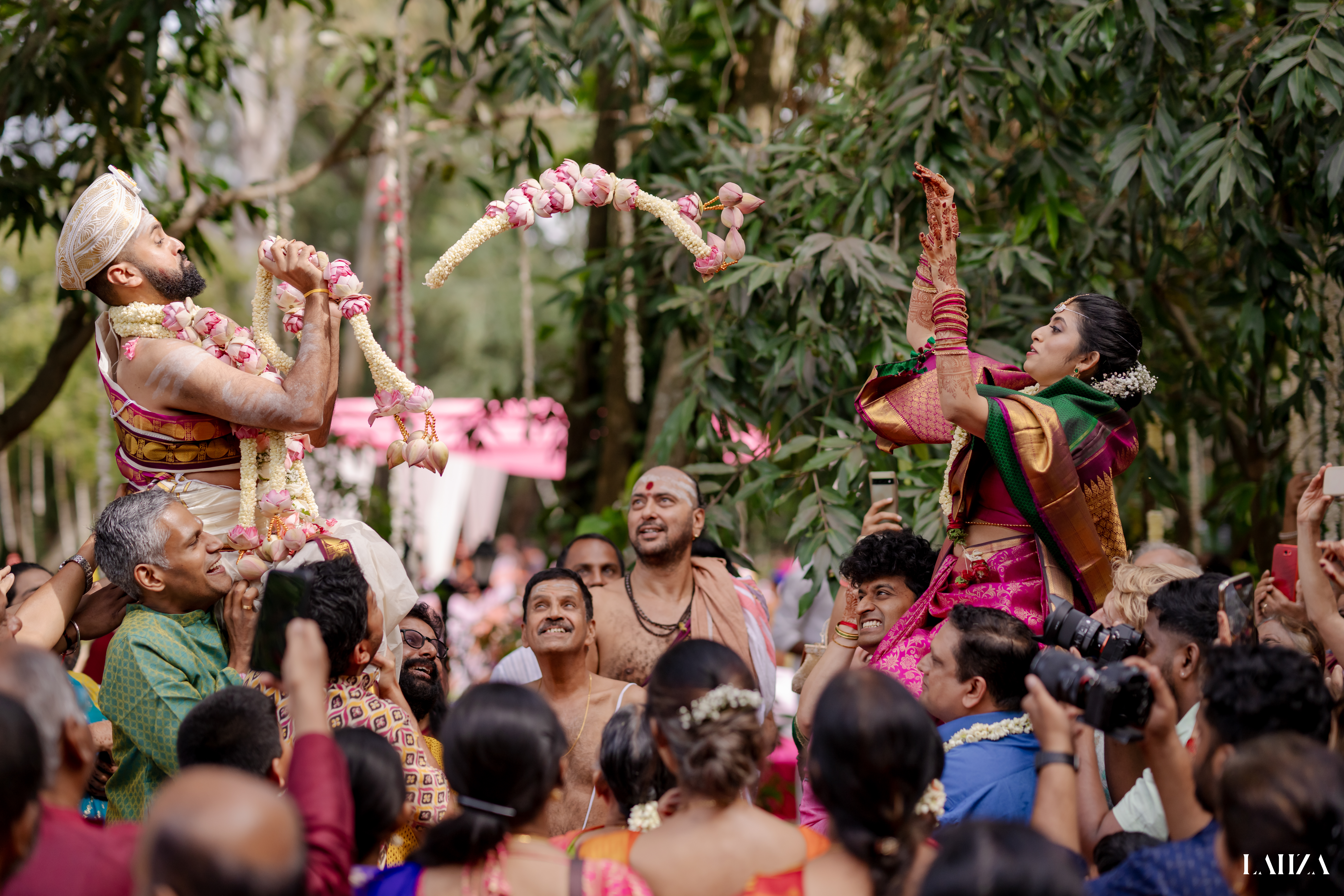
The best wedding photos in a crowded venue are not the ones where the crowd is invisible. They are the ones where the crowd adds meaning. A grandmother wiping a tear in the background. A group of friends laughing at a private joke. The chaos is part of the story.
Here is how to make the crowd work for you:
Shoot through the crowd. Use people in the foreground as natural frames. A shoulder in soft focus can draw the eye to the couple in the center.
Wait for the wave. Crowds move in rhythms. People stand, sit, cheer, and shift. Anticipate the moment when the space clears, even if it only lasts a second.
Embrace the candid. Some of the most emotional photos happen when no one is posing. The bride laughing with her friends, the groom adjusting his turban. These moments are gold, and they happen in the middle of the noise.
Use flash sparingly. Direct flash flattens the scene and highlights the crowd. Bounce flash or natural light keeps the depth and the mood.
Communicating With the Couple Before the Day
Your job as a photographer is not just to take photos. It is to set expectations and build trust. A couple who understands how you work will be more relaxed, and that relaxation shows in every frame.
Send them a short note before the wedding. Explain that you will be moving through the crowd, that you will pause for key moments, and that you will not stop the flow of the event unless absolutely necessary. This simple step prevents confusion and anxiety on the day.
Also, ask about the venue layout in advance. Where are the exits? Is there a balcony? Which areas are likely to be packed? Knowing the geography helps you plan your moves before the chaos begins.
What to Do When the Crowd Is Unavoidable
Sometimes, there is no pocket, no gap, no quiet corner. The room is a solid mass of people. In that case, change your approach entirely. Do not fight it. Embrace it.
Shoot the crowd itself. The energy of a hundred people celebrating is a story worth telling. Get shots of hands raised, faces lit with joy, and the couple at the center of it all. These photos are not a compromise. They are a different kind of beautiful.
The Final Frame
A crowded venue is not a limitation. It is a condition of the day, like the weather or the lighting. The photographers who deliver exceptional work are the ones who adapt, who see the opportunity in the chaos, and who never stop moving.
When you look back at your wedding photos, you will not remember the crowd. You will remember the way your partner looked at you, the laughter of your friends, and the warmth of the room. That is what we are there to capture.
If you are planning a wedding and worried about the venue size, talk to your photographer about these strategies. A good photographer will not just reassure you. They will show you how they have handled similar situations before. That confidence is worth more than any equipment.